- Last Harvest



Picked for you

Affordable price

Esclusively on Nuturally


Your cart is empty

Fill it with nuts!
Nuturally is a Euro Company SpA Società Benefit brand
Free shipping for orders above 59€. Right of withdrawal from your order in accordance with Directive 2011/83/EU within 14 days of delivery.
Secure payments with PayPal, Credit cards/Prepaid cards. Minimum order value: 29€.
Food safety with over 2,000 raw material controls
Picked for you
Affordable price
Esclusively on Nuturally
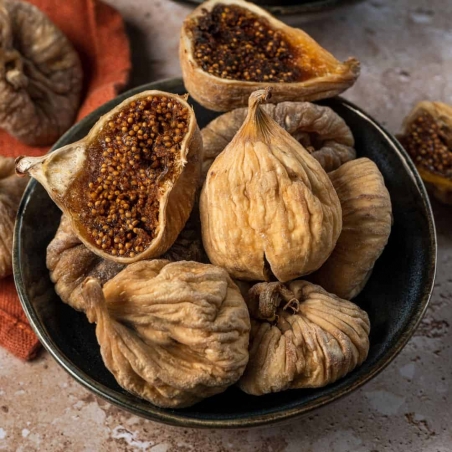
Buy online natural dried figs with no added sugar – containing only natural sugar
We have selected big-size dried figs only, in order to provide you with giant figs (calibre 2). Our dried figs are grown with care and attention, respecting our supply chain and the values in which we believe: respect for people and for the planet.
Being dried fruit experts, we have selected natural dried figs that are large, fleshy, and delicious.
You can buy dried giant figs in packs ideal for true dried fruit lovers.
Our analyses have shown that 100 g dried figs contain:
Ingredients: Figs. May contain traces of PEANUTS and NUTS.
Origin: Turkey

Nutritional values
| Ingredients | Figs. May contain traces of PEANUTS and NUTS. |
| Weight | 1 kg |
| Storage requirements | Store in a cool, dry place |
| Nutrition declaration | average nutritional values per 100 g: |
| Energy | 1213 kJ / 287 kcal |
| Fats | 1.9 g |
| of which saturates | 0.3 g |
| Carbohydrate | 60 g |
| of which sugars | 56 g |
| Fibre | 10 g |
| Protein | 2.5 g |
| Salt | 0.25 g |
| Copper | 0.33 mg (33% NRV*) |
| Potassium | 804 mg (40% NRV*) |
| Source | Euro Company analysis |
| Recommendations | The advice provided SHOULD IN NO WAY BE CONSIDERED AS MEDICAL ADVICE OR PRESCRIPTION. The information provided shall be considered for informative and educational purposes only, it is not intended to replace medical advice. In case of a medical condition, always consult your doctor. |
| Origin | Turkey |
| Nutrients | Copper, Fibre, Potassium |
| *NRV: Nutrient Reference Value | *Nutrient Reference Value |
| Label and packaging | The images are for illustrative purposes only, the product may be subject to changes depending on stock availability and selected weight. |
| Product | Figs |
Curiosity
Figs were a fruit well-known to the people of antiquity such as Greeks and Romans. They are also mentioned in the Old Testament as a symbol of abundance. Grown as a rare and sought-after delicacy in the gardens of paradise of the Babylonians, the fig was revered by the Egyptians as the tree of life and immortality, from which every day Ra, the Sun God, was reborn, and from which the most precious wood was hewn out for the sarcophagi intended to accompany the deceased in the afterlife. The fig tree known by the Egyptians was the sycamore (Ficus sycomorus), while that grown in Rome was the Ficus ruminalis, the plant of Fortune, protector of the domestic hearth, and connected to the foundation of Rome. It was, indeed, in the shade of its leaves that the she-wolf suckled Romulus and Remus. The fig was also sacred in Greece, where it was connected with Dionysus, the god of life-blood and natural energy. And in primitive agricultural cults, the “revelation of the fig tree” was a ritual of initiation into the secrets of fertility.
Many parts of the fig have therapeutic properties, such as new buds: their activity is due to the digestive enzymes which it contains. They regulate gastroduodenal motility and secretion, especially in people with psychosomatic reactions in their gastrointestinal tract. Leaves: collected from May to August and dried slowly, they contain furocoumarins, bergapten, psoralen, coumarins, latex. They also have haemagogic, anti-inflammatory, expectorant and digestive properties, although the fucomarines can cause problems with photosensitivity. Immature fruit, green parts and young shoots: the latex that flows from cuts contains amylase and protease and can be applied to remove corns and warts through its caustic and proteolytic action. It should be used with caution as it can burn or irritate the skin.
Fresh fruits: they have a laxative effect when taken in great quantity. Dried fruit: rich in vitamins A and B, protein, sugar and mineral salts (Potassium, Magnesium, Calcium), they have emollient, expectorant and laxative properties. Remember, however, that the leaves also can also cause irritation to the skin when rubbed against it and the sensation is aggravated by heat or exposure to ultraviolet radiation, especially in individuals with a predisposition to this. However, it can be alleviated by simply rinsing the skin with water and avoiding direct, or even indirect, sunlight for several hours. It is widely believed that latex helps people tan; in reality, application of fig latex on the skin and subsequent exposure of this to intense sunlight leads to injuries and burns, some of which can be quite serious.
The wild fig, or Caprifico (Ficoraccia) was historically used in the Italian region of Lazio as a danger warning at the openings of the drainage tunnel wells typical of some areas within the Veio Regional Park, which, scattered as they are throughout the valleys for the purpose of draining storm water, present (even today) a real hazard for people and farm animals alike. The Ficoraccia was also artificially planted on land used for grazing but with no shade to provide shelter from the summer sun to people and animals in the pastures.
Source:
Nutspaper, 2/2011
History
The fig tree (Ficus Carica L.) is a plant of ancient origins, coming from the Middle East. The specific epithet 'Carica' refers to its origins, which can be traced back to Caria, a region of Asia Minor. Evidence of its cultivation was already visible in the first agricultural civilizations of Mesopotamia, Palestine and Egypt, from where it later spread throughout the Mediterranean Sea basin. Even though by definition it is called the Mediterranean Fig, the fig is also considered historically originating from and common to the Caucasus and the Black Sea regions. Only after the discovery of America did the fig spread to that continent, and following contacts with the East it spread to China and Japan.
The fig is part of the Moraceae family which includes about 1500 species, most of which are woody plants, although it does also contain some herbaceous and creeping plants. The species in this family produce latex. There are two subspecies of the Genus Ficus carica L.: Ficus carica sativa (domestic fig) and Ficus carica caprificus (caprific or wild). The Ficus carica L. is the most Nordic species of the genus; the tree in its natural state lives, on average, 50–90 years. It can reach 10–12 m in height, but in specialized farming it is kept within 3–4 m. In its wild state, its shape can be shrubby, while its grown form is arboreal.
The cultivation of fig trees has developed in different parts of the planet, but of course only significantly in climate districts similar to the hot and arid Mediterranean environment. In the Mediterranean basin we have important cultivation areas in Italy, Turkey, Greece, Algeria, Spain, Libya, Morocco, Egypt, Palestine, France. Other major producing countries are Portugal, Syria, Russia, Arabia, India, Japan, California, Argentina, Australia. The Italian regions dedicated to its production are Puglia, Campania and Calabria. Abruzzo, Sicily and Lazio are also major producers.
Source:
Nutspaper, 2/2011
Properties
According to our analyses, 100 g of figs contain:
Dose recommendations
Each package of 1 kg of dried figs contains about 32 portions of 30 g that provide:
Individual needs vary by age, gender, weight and physical activity. A varied and balanced diet and a healthy lifestyle are the basis of your well-being.
Affordable price
For us, an affordable price means offering dried figs that are accessible to everyone.
We select our producers based on our values to offer you only natural nuts and dried fruit with no added sugar (contains naturally occurring sugars). What’s more, by choosing larger pack sizes of dried figs, you too are helping to reduce plastic use, as larger packs require less packaging per kilogramme of product than smaller ones.
How much does 1 kg of dried figs cost?
The price per kg for dried figs depends on the figs' quality, variety and origin. On Nuturally, we have selected the best dried figs with respect for our supply chain, farmers, and raw materials.
Storage
You can store dried figs in cool, dry places away from heat and moisture. Here are 4 useful tips:
Questions & Answers by lovers of Dried Giant Figs
FAQ about Dried Giant Figs: Questions & Answers by nut lovers
Be the first to ask a question about this product!
Products of the month
We recommend that you buy Dried Giant Figs together with these products:
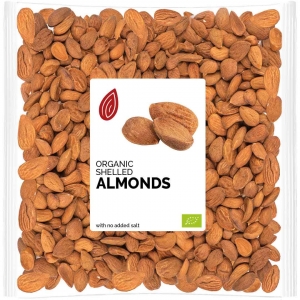
Italian Organic Shelled Almonds
Our Italian Organic Shelled Almonds with no added salt and no preservatives are grown in the respect of the environment. Try them now and support quality agriculture with us!
Show productShelled Italian Walnut Quarters
Our delicious shelled Italian walnut quarters are ready to eat or to add to both sweet and savoury recipes. Buy now.
Show product