

Picked for you

Affordable price

Esclusively on Nuturally


Your cart is empty

Fill it with nuts!
Nuturally is a Euro Company SpA Società Benefit brand
Free shipping for orders above 59€. Right of withdrawal from your order in accordance with Directive 2011/83/EU within 14 days of delivery.
Secure payments with PayPal, Credit cards/Prepaid cards. Minimum order value: 29€.
Food safety with over 2,000 raw material controls
Picked for you
Affordable price
Esclusively on Nuturally
[In keeping with seasonal availability, apricots will be back in stock with the new harvest starting in October 2026]
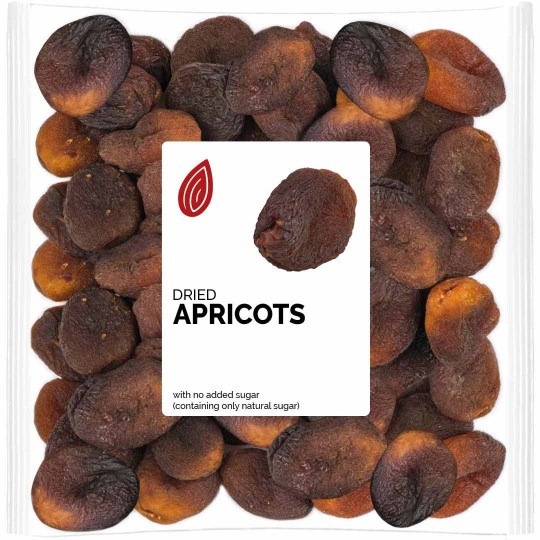
Buy online dried apricots with no added sugar (containing only natural sugar).
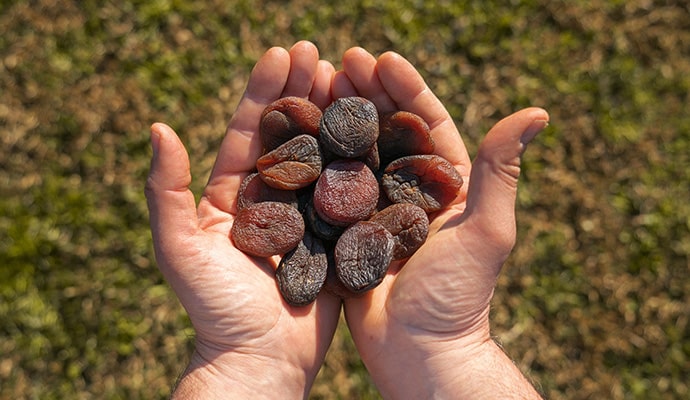
As experts in dried apricots, we have selected only sugar-free dried apricots with their characteristic dark colour, which comes from their natural state and the absence of preservatives. Our dried apricots are sun-dried and grown every day in accordance with the values we believe in: only dried apricots with no added sugar (containing only natural sugar) to guarantee a product of the very highest quality in a large pack and at an affordable price.
You can buy dehydrated apricots in packs that are ideal for true nut lovers.
Discover the benefits of dried apricots! Our analyses showed that 100 g of dried apricots contain:
The characteristic dark colour is a result of the naturalness of the product and the absence of preservatives.
Ingredients: Apricots, shea oil. May contain PEANUTS and NUTS.
Formats: 1 kg, 2.5 kg
Origin: Turkey
Nutritional values
| Ingredients | Apricots, shea oil. May contain PEANUTS and NUTS. |
| Weight | 1 kg, 2.5 kg |
| Storage requirements | Store in a cool, dry place |
| Nutrition declaration | average nutritional values per 100 g: |
| Energy | 1234 kJ / 291 kcal |
| Fats | 0.5 g |
| of which saturates | 0 g |
| Carbohydrate | 65 g |
| of which sugars | 34 g |
| Fibre | 7.4 g |
| Protein | 3.0 g |
| Salt | 0.01 g |
| Copper | 0,37 mg (37% NRV*) |
| Potassium | 1330 mg (67% NRV*) |
| Source | Euro Company analysis |
| Recommendations | The advice provided SHOULD IN NO WAY BE CONSIDERED AS MEDICAL ADVICE OR PRESCRIPTION. The information provided shall be considered for informative and educational purposes only, it is not intended to replace medical advice. In case of a medical condition, always consult your doctor. |
| Origin | Turkey |
| Nutrients | Copper, Fibre, Potassium |
| *NRV: Nutrient Reference Value | *Nutrient Reference Value |
| Label and packaging | The images are for illustrative purposes only, the product may be subject to changes depending on stock availability and selected weight. |
| Product | Apricot |
Curiosity
The apricot is the fruit of the apricot tree (Prunus Armeniaca). Family: Rosaceae, Genus: Prunus, Species: Prunus Armeniaca. The plant belongs to the same family and variety of fruit as cherries, peaches and plums. It is a deciduous leaf tree that can reach 12-13 metres in its wild state. However, human-grown plants are kept under 3.5 metres in order to facilitate the harvesting of the fruit. It has an umbrella crown, with a trunk and thin slightly twisted branches. The leaves are elliptical, with sharp tips and serrated edges, and violet-red petioles. The average width is 7-8 cm, but it varies from one cultivar to another, even if it is still wider than other plants of the same family. The flowers are very similar to those of their cousins (cherry, plum and peach), they are single but bloom in small groups located where the leaves are attached to the branch. They have five sepals and petals, many standing stamens and vary from pure white to a light pink colour. The plant is usually pollinated by insects (bees) and does not require manual pollination. It does not normally show any signs of self sterility and therefore even single trees fruit regularly. The harvest season is in June, July, and August.
Apricots must be picked when well-ripe and are consumed within a few days as they are perishable fruits. Because of their fragility, they are stored or treated in many ways: dried (especially in the USA), in syrup, and also stored in cans or frozen. There are also many products derived from them such as juice, jam and apricot gelatin, which is largely used in a process called 'apricottatura' (derived from the English 'apricot' and introduced into Italian) used in baking cakes and pastries. 'Apricotattura' consists of brushing the surface of a cake with apricot gelatine before glazing it; a classic example of this popular technique is the famous Sachertorte.
Apricots are usually used in the preparation of desserts of various types, such as ice creams, sorbets, jams and jellies, juices and syrups, cakes and pastries. However, their slightly acidic taste makes them suitable also for salty combinations, such as sauces accompanying red meat. They are also used in liqueurs: an apricot brandy, distilled in the Canton of Valais in Switzerland, has the name of Abricotine, and the most popular of these comes from an ancient variety, the Luizet. The Balkans also have their own apricot spirit called Kajsija.
A legend says that originally the apricot was only an ornamental plant with beautiful white flowers. When Armenia was invaded by its enemies, the order went out to cut down all the trees that did not produce fruit to get timber. And this would have been the fate of the apricot if a girl had not wept under its canopy for the whole night. By morning, golden fruits had grown on the tree: apricots. In other legends, the apricot is also shown as the forbidden fruit tasted by Adam and Eve instead of the apple. According to the Arab medical treaties it was used as a cure for earache. In the popular English tradition, dreaming of apricot brings luck, while elsewhere it symbolizes shyness in love; according to another version, if you dream of dried apricots, it is an omen of loss and destruction.
Source:
https://it.wikipedia.org/wiki/Albicocca
Nutspaper 'Dried Apricot' 1/2016
History
The origin of the apricot is threefold as it comes from China, Central Asia and the Caucasus, all areas where the species has been widespread since 3000 BCE. Thanks to the merchant caravans, it spread slowly from those regions to the West, through central Asia, reaching Armenia and the Middle East. Its botanical binomial Prunus Armeniaca owes its name to Linnaeus' conviction that the plant was of Armenian origin. Armenia is still a fundamental diffusion point of this tree, as it was the place from where it was introduced to Greece and Italy, primarily due to the expeditions of Alexander the Great, and then of the Roman general Lucullus, who both acquainted the West with the different varieties of the plant, until then unknown. The Romans introduced it to Italy and Greece in 70-60 BCE, but its spread around the Mediterranean basin was later consolidated by the Arabs. Until the last century, however, apricots were not particularly widespread in Europe or in America, which was reached thanks to the English settlers. The tree also grows naturally in the Himalayas at altitudes of around 3,000 metres as a result of its stem's resistance to the cold climate. As for the name, the Romans called it Armeniacum, which means Armenian apples, because it originated from there; or praecox, which in Latin means ‘early’ because it matured before peaches; from such root we also derive the Greek term 'praikokion'. 'Albicocca' in Italian – as well as the French ‘abricot’, the English ‘apricot’ and the Spanish ‘albaricoque’ – comes instead from the Arabic ‘albarquq’. In turn, the fruit gave its name to a shade of light orange, halfway between yellow and pink.
Apricots can be considered as a source of different phytocomposts such as polyphenols and carotenoids. The polyphenols, such as quercetin and catechin, have a high antioxidant and anti-inflammatory effect which helps reducing the risk of cardiovascular disease. Catechin, also responsible for the beneficial effects of green tea, acts by inhibiting the action of pro-inflammatory enzymes. There are also studies that demonstrate how a diet full of catechins can help protecting blood vessels and keep blood pressure under control. Carotenoids are lipid-type vegetable compounds distinguished by their yellow-red colour. They can have both a vitamin effect as precursors of vitamin A and antioxidant activity. Among the carotenoids, we have xanthophylls, compounds that have been the subject of several studies to demonstrate their protective effect on eyesight. Lutein, one of these, is mainly associated with an effect of protection of the retina, the membrane of the eyeball that acts as a light-converter, picking up the light stimuli and converting them into bioelectrical signals, which, in turn, are sent to the brain through the optic nerve fibres. Apricots are rich in fibre, which is essential for the health of the digestive system. A lot of this fibre is soluble and also helps regulating blood cholesterol levels. These fruits are also rich in potassium, a mineral that plays many roles in the body: for example, it plays a crucial role in the functioning of the nervous and muscular systems and helps keeping blood pressure normal.
Source:
Regulation (EU) No. 432/2012 Commission Regulation (EC) dated 16 May 2012
Nutspaper 'Dry Apricot' 1/2016
Properties
According to our analyses, 100 g dried apricots contain:
Dose recommendations
Each 1 kg package of dried apricots contains about 32 portions of 30 g that provide 20% of the Nutrient Reference Value of Potassium. The beneficial effect of Copper is obtained by a daily intake of about 41 g of product.
Individual needs will vary according to age, gender, weight and physical activity. A varied and balanced diet and a healthy lifestyle are the basis of your well-being.
NB: The characteristic dark colour is a result of the naturalness of the product and the absence of preservatives.
Affordable price
For us, an affordable price means offering dried apricots that are accessible to everyone.
We select our producers based on our values to offer you only natural nuts and dried fruit with no added sugar (contains naturally occurring sugars). What’s more, by choosing larger pack sizes of natural dried apricots, you too are helping to reduce plastic use, as larger packs require less packaging per kilogramme of product than smaller ones.
How much does 1 kg of dried apricots cost?
The price per kg for dried apricots depends on the apricots' quality, variety and origin. On Nuturally, we have selected the best dried apricots with respect for our supply chain, farmers, and raw materials.
Storage
You can store naturally-dried apricots away from sources of heat and moisture. Here are 4 useful tips:
Questions & Answers by lovers of Dried Apricots
FAQ about Dried Apricots: Questions & Answers by nut lovers
Be the first to ask a question about this product!
Products of the month
We recommend that you buy Dried Apricots together with these products:
Try right away our tiger nut cream made with only organic tiger nuts and no added sugar.
Show productTry our natural Chopped Pistachios in large packs for nuts lovers for your delicious recipes!
Show product